
Workers’ compensation claims are not automatic public documents in the United States. These claims have their own special place in public records law. While the documents are not completely private like personal medical records, neither are they totally public, like most legal documents tend to be.
In 2025, the number of claims filed for workers’ compensation continued to decrease. Even though there were fewer claims being filed, industry studies conducted in 18 different states showed that the cost of workers’ compensation claims increased by six percent annually from 2022 to 2025.
Construction accident lawyer Weston S. Montrose says that workers’ compensation serves as the exclusive remedy for injured workers whose employers have workers’ compensation insurance.
But still, most workers worry about two things when they submit the claim. They worry that unauthorized individuals may access their medical records. Another concern is that employers may use their submitted claim as a ground for discrimination in a future job.
Understanding what information is accessible, who can access it, and under what circumstances can help address those concerns.
Table of Contents
What Is and Is Not Accessible to the Public
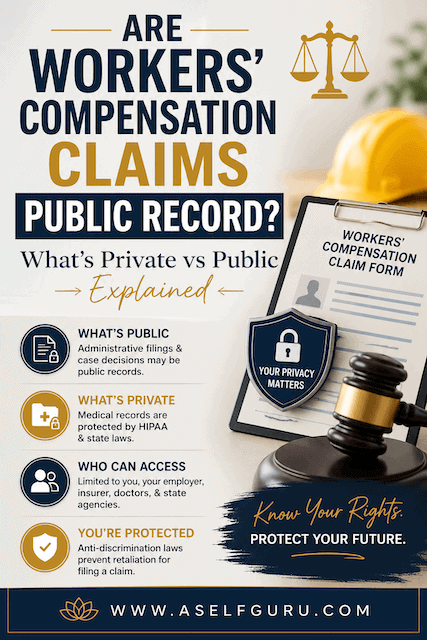
The admin filings that go with a workers’ compensation claim might be obtainable via a state workers’ compensation board or agency depending on that state’s rules. These filings include information such as the kind of injury involved, the date of the incident, and the identity of the employer.
State laws determine whether the public can access information related to workers’ compensation claims. Are workers’ compensation claims in Illinois a public record?
In Illinois, workers’ compensation claims are mostly public records, but some info, especially anything from medical records or other sensitive personal data, is kept confidential and won’t be easily disclosed to the public.
Once a case moves into a more formal hearing or appeal and it gets handled by a workers’ compensation tribunal, those steps usually turn into an adjudicative record. In most states, these records, like other court papers, become public.
Medical records are a different situation. Pursuant to the HIPAA Privacy Rule, a patient’s medical information is considered protected health information and cannot be disclosed.
HIPAA permits healthcare providers, including doctors, hospitals, and clinics, to share a patient’s medical information without written consent if the release is necessary or allowed under worker’s compensation statutes.
These disclosures also encompass information to be shared with worker’s compensation insurers and state workers’ compensation agencies or boards. Employers can gain access to workers’ compensation information in limited circumstances permitted by the law.
When Claims Become More Public: Appeals and Adjudication
A claim that stays in the administrative lane, filed, investigated, and wrapped up without any real contest, often ends up more private.
Once a claim is denied and the employee goes and files an appeal with a workers’ compensation appeals board, the whole process becomes more formal. The latter rulings are usually published or at least accessible as public records documents.
Employers may only look at older claim records after they make a conditional offer of work. Access to these records may also be allowed when the purpose is to check whether the earlier injury would clash with or limit the applicant’s capacity to carry out the particular job.
Who Can Legally Access Your Claim
Access to workers’ compensation claim files is usually pretty restricted to certain groups.
In many states, the following people can look at claim info without needing extra authorization:
- The injured worker, who gets full access to their own file, at any point in time
- The employer and the employer’s legal representatives
- The workers’ compensation insurer or the third-party administrator, along with their attorneys
- Treating physicians and independent medical examiners, but usually they’re limited to the data that’s needed for care, and for evaluation
- Staff from the state workers’ compensation board who are actually processing the claim
- Courts, if it turns into litigation connected to the claim
Prospective employers really don’t fit into these categories. In some states, a prospective employer cannot require a job applicant to sign off on access to old workers’ compensation records.
Most states typically treat using information from a workers’ compensation claim to refuse a candidate as unlawful discrimination.
HIPAA, Workers’ Compensation, and the Minimum Necessary Standard
Health and Human Services (HHS) regulations state that while HIPAA applies to healthcare providers, it does not apply to workers’ compensation insurers or state agencies in the same manner. Healthcare providers can disclose relevant treatment information without prior consent of patients if required by workers’ compensation laws.
Keep in mind that such disclosures have their limits. Healthcare providers are allowed to disclose only the minimum amount of protected health information required by workers’ compensation laws. Employers usually do not have the right to obtain a worker’s whole medical file.
When someone makes a request for broad medical authorization, the worker does not have to sign it. The authorization may pertain only to the documents relevant to the workplace injury. Preexisting medical conditions of a worker are usually kept confidential.
Retaliation and Anti-Discrimination Protections
Making a claim under the workers’ compensation system does not mean that your employer has the right to discriminate against you.
Most states forbid retaliation and discrimination against employees in connection with making a claim.
The Practical Picture
A workers’ compensation claim does not affect your criminal history. It will not show up on normal background checks unless someone knows of the existence of the claim and takes action to locate it intentionally.
It should be noted that adjudicated cases and appeal board-type decisions tend to be more accessible than the administrative claims.
The confidentiality of the medical information generated by the claim procedure is guaranteed but the information is not sealed until the claim procedure is completed.
If you are a worker concerned about the confidentiality of your workers’ compensation claim or have felt discrimination based on a previous claim, you should definitely study the specific state laws governing the situation.
You can obtain additional information on the state-by-state regulations regarding the accessibility of the records, confidentiality provisions, and antidiscrimination rights through the Department of Labor workers’ compensation resources or state workers’ compensation board websites.