As a business lawyer who has guided thousands of founders through the maze of entity formation, I’ve seen firsthand how one early decision can shape a company’s future. The choice between operating as a sole proprietor and forming a Limited Liability Company (LLC) is often the first major fork in the road.
Table of Contents
Introduction: Your First Big Decision (LLC vs. Sole Proprietorship)
Your freelance business or side-gig is finally making real money. Congratulations!
That’s a huge milestone. But now you’re facing a critical decision that feels confusing and high-stakes: should you remain a sole proprietor or form an LLC?
Most guides drown you in legalese, making the choice feel more complicated than it needs to be. This one is different. This is what I, as a lawyer, would actually do if I were in your shoes.
I’ll give you a simple, one-minute decision matrix to get a clear answer based on your specific situation.
Then, I’ll provide a complete playbook to make the change, complete with a video walkthrough, a downloadable checklist, and real-world case studies so you can move forward with confidence.
Video Walkthrough: The Lawyer’s POV on LLC and Sole Proprietorship
To get started, watch this video where I walk through the core decision points and show you exactly what to consider.
The 1-Minute Decision Matrix: Should You Form an LLC?
To get an immediate, actionable answer, find your business profile in the matrix below. This framework cuts through the complexity and gives you the same recommendation I’d give a client in a private consultation.
I recommend booking a consultation to discuss your specific cirumstances because each business is different.
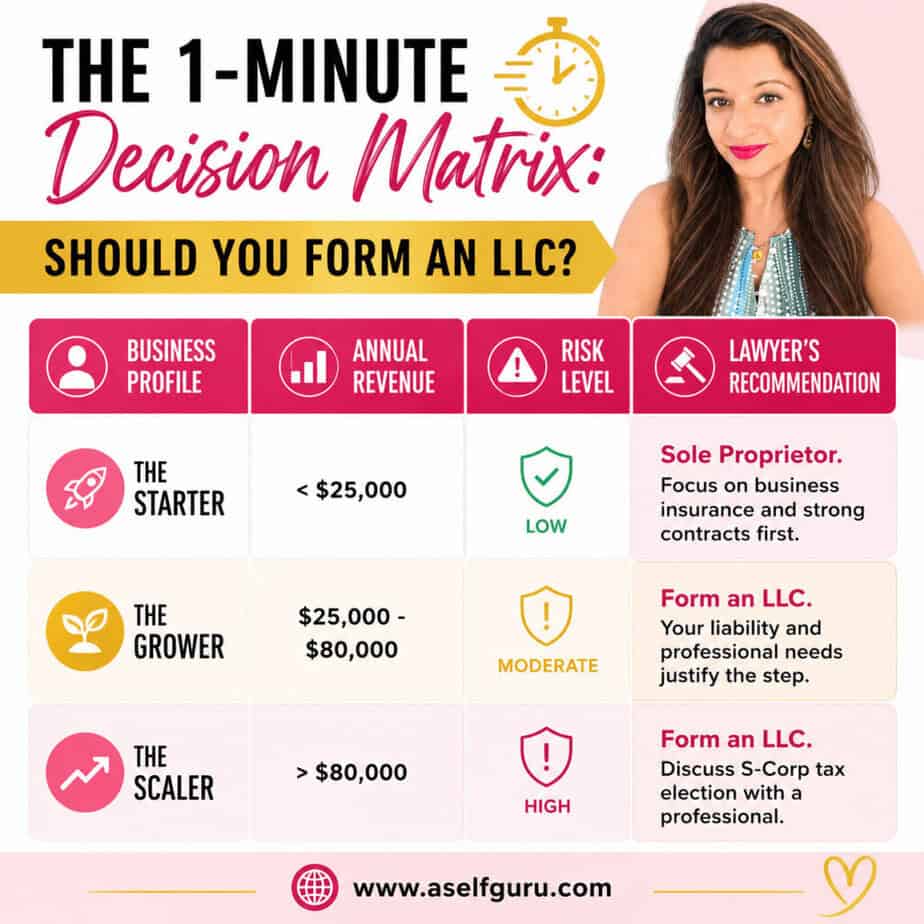
Low-Risk & Low-Revenue (<$25k/year)
If you’re just getting started in a low-risk field like freelance writing, graphic design, or virtual assistance, a sole proprietorship is likely sufficient.
At this stage, your primary goal is to validate your business model without incurring unnecessary overhead.
The costs and annual compliance requirements of an LLC might be a premature burden.
Instead, your best risk-management tools are a strong client contract that outlines your responsibilities and a general liability insurance policy.
For a freelancer starting out, the overhead of an LLC vs Sole Proprietor might not be worth it; insurance provides a more cost-effective shield for early-stage risk.
Moderate-Risk or Growing Revenue ($25k-$80k/year)
This is the inflection point for most businesses.
Once your revenue starts to become significant or your business activities carry inherent risk (e.g., you sell physical products, offer coaching, or handle sensitive data), the scale tips in favor of forming an LLC.
As your income grows, you begin to accumulate personal assets you want to protect from business-related liabilities.
Furthermore, as you pursue larger clients, you’ll find that many require their vendors to be incorporated.
An LLC signals professionalism and permanence.
Once you have meaningful business assets, the Sole Proprietor vs LLC question tilts heavily toward the liability protection an LLC offers.
High-Risk or High-Revenue (>$80k/year)
If your business operates in a high-risk industry (like construction, transportation, or anything involving health and safety) or your annual revenue is approaching six figures, an LLC is a non-negotiable.
The potential for a lawsuit, employee issue, or business debt is too great to leave your personal assets, your home, car, and savings exposed.
At this level, choosing an LLC vs Sole Proprietor is less of a question than a necessity for asset protection and tax planning.
This is also the stage where you should seriously explore electing S Corporation tax status for your LLC.
This strategy can significantly reduce your self-employment tax bill, potentially saving you thousands of dollars each year.
The Core Differences: Liability, Taxes, and Costs
Understanding the three pillars of the decision: liability, taxes, and costs will solidify your choice and prepare you for what comes next.
Liability: Your Personal Asset Shield
This is the single most important reason to form an LLC.
As a sole proprietor, you and your business are legally the same entity.
If your business is sued or racks up debt, your personal assets are fair game.
An LLC creates a separate legal entity, building a protective wall often called the “corporate veil” between your business and personal finances.
This means if your LLC defaults on a loan or loses a lawsuit, creditors and plaintiffs can generally only go after the assets owned by the LLC itself. Your personal bank accounts, home, and car are protected.
However, this protection is not absolute.
Understanding the difference in liability between a Sole Proprietorship vs LLC is the most critical factor for most founders, but you must know its limits.
A court can “pierce the corporate veil” if you fail to maintain the separation between you and your business.
This can happen if you commit fraud, co-mingle personal and business funds, or fail to follow corporate formalities.
Liability protection also won’t cover your own personal negligence (e.g., you cause a car accident while driving for work) or if you personally guarantee a business loan.
Taxes: Self-Employment Tax, Pass-Through, & the S-Corp Election
By default, both a sole proprietorship and a single-member LLC are “pass-through” entities for tax purposes.
This means the business itself doesn’t pay income tax.
Instead, the profits and losses “pass through” to your personal tax return, and you pay income tax and self-employment taxes (Social Security and Medicare, currently 15.3%) on all net earnings.
The IRS guide to LLC tax classification and requirements confirms this default status, treating a single-member LLC as a “disregarded entity” identical to a sole proprietorship for tax purposes.
This is where the S Corp election becomes a powerful tool.
An LLC can elect to be taxed as an S Corporation.
This allows you to split your earnings into two categories: a reasonable salary and a profit distribution.
You only pay the 15.3% self-employment tax on your salary, not on the distributions.
Let’s compare the tax implications of Sole Prop vs LLC with a worked example of the S corp election.
Scenario: A software developer LLC earns $150,000 in net profit.
As a Default LLC (or Sole Proprietor):
- Net Profit: $150,000
- Self-Employment Tax (15.3% of $150,000): $22,950
- As an LLC with S-Corp Election:
- The owner pays themselves a “reasonable salary” of $80,000.
- The remaining profit is $70,000, taken as a distribution.
- Self-Employment Tax (15.3% of $80,000 salary): $12,240
- Profit Distribution: $70,000 (Not subject to self-employment tax)
- Annual Tax Savings: $10,710
To make this election, you must file Form 2553 with the IRS.
The IRS explanation of S corporation election and rules outlines the specific eligibility requirements and filing deadlines. This strategy adds some payroll complexity but can offer substantial savings for high earners.
Costs & Timing: What to Budget For
Forming an LLC is not free. There are one-time filing fees and ongoing annual costs. The cost to form an LLC can vary from under $100 to over $500 depending on your state’s filing fees. You’ll also have recurring annual report fees, which can range from $0 to several hundred dollars.
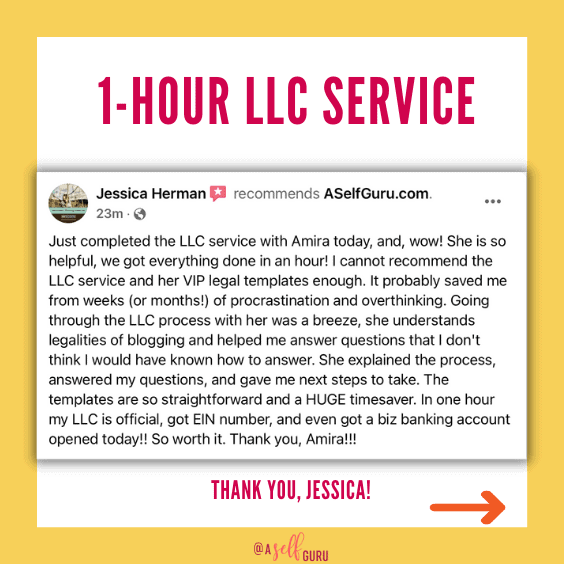
You can file yourself directly with your state’s Secretary of State office, or can work with a lawyer like me to file your LLC in an hour.
I don’t recommend LLC formation services like Legal Zoom because of the errors they make and entrepreneurs always end up coming to me to fix those mistakes later. This ends up costing them more money and time.
A DIY approach is cheapest but requires careful attention to detail.
The Conversion Playbook: From Sole Proprietor to LLC Today
Ready to make the switch? Follow this step-by-step playbook. Make sure to bookmark and save this post!
Step 1: File Your Articles of Organization
This is the official document that creates your LLC.
You’ll file it with your state’s Secretary of State (or equivalent agency).
Key information you’ll need includes your chosen LLC name, your business address, and the name and address of your registered agent (the person or service designated to receive official legal mail).
Before filing, perform a business name search on your state’s website to ensure your desired name is available.
Step 2: Get a Federal EIN
Once your LLC is approved, you need to obtain a new Employer Identification Number (EIN) from the IRS.
This is like a Social Security Number for your business. Even if you had an EIN for your sole proprietorship, you must get a new one for the newly formed LLC.
This is a critical step in establishing the LLC as a separate legal and tax entity.
You can apply for free directly on the IRS EIN application page.
Step 3: Draft an Operating Agreement
An Operating Agreement is the internal rulebook for your LLC.
It outlines ownership, how profits and losses are distributed, and how the business will be managed.
Even if you are a single-member LLC, you need one. It’s crucial evidence that you are treating the LLC as a separate entity, which helps preserve your corporate veil.
It also provides a clear plan for what happens to the business if you can no longer run it.
Click here to download our simple LLC Operating Agreement Template (works for both single and multi-member LLCs)

Step 4: Open a Business Bank Account
This is the most important practical step for preserving your liability protection.
You must open a dedicated business bank account in the LLC’s name using your new EIN.
From this point forward, all business income must be deposited into this account, and all business expenses must be paid from it.
Never pay personal bills from the business account or business bills from your personal account. Comingling funds is the fastest way to have a court pierce your corporate veil.
Step 5: Update Your Contracts, Insurance & Payment Systems
The final step is to transfer your business operations to the new LLC. This includes:
Contracts: Update all client agreements, vendor contracts, and leases to be in the name of the LLC, not your personal name.
Insurance: Contact your business insurance provider and update your policy to list the LLC as the named insured.
Payment Processors: Change the business information on file with services like Stripe, PayPal, and Square to reflect the LLC’s name and EIN.
Website & Marketing: Update the legal name on your website footer, privacy policy, and any other public-facing materials.
Real-World Scenarios: Mini Case Studies
Let’s see the decision matrix in action with a few common scenarios.
The Freelance Consultant: Moving Upmarket
Situation: A marketing consultant is earning $70,000 per year from a mix of small and medium-sized clients. She’s starting to pitch larger corporate clients who have formal vendor onboarding processes.
Decision: Form an LLC.
Outcome: The LLC professionalizes her business, allowing her to meet the “incorporation required” checkbox on enterprise client applications. It also separates her growing business income from her personal savings, providing peace of mind as she takes on higher-stakes projects.
The E-commerce Side-Hustler: Managing Risk
Situation: A founder sells handmade candles and soaps online, grossing about $40,000 a year as a side-hustle. While the products are made with care, there is a small but present risk of a customer having an allergic reaction or a candle causing property damage.
Decision: Form an LLC.
Outcome: The LLC shields his personal assets – his home, car, and family’s savings from a potential product liability claim. The cost of the LLC is a small price to pay for the protection against a lawsuit that could otherwise be financially devastating.
The High-Earning Developer: Tax Savings
Situation: A freelance software developer is grossing $150,000 per year. As a sole proprietor, his entire net profit is subject to the 15.3% self-employment tax.
Decision: Form an LLC and elect S-Corp tax status.
Outcome: He works with his accountant to set a reasonable salary of $80,000, paying self-employment tax only on that amount. The remaining $70,000 is taken as a profit distribution, which is not subject to self-employment tax. This single move saves him over $10,000 in taxes annually.
Staying Compliant: A Practical Corporate Veil Checklist
Forming the LLC is just the beginning.
To keep your liability shield intact, you must consistently operate the business as a separate entity.
Follow this simple checklist above for ongoing compliance.
Use Your Business Bank Account Exclusively
Do not comingle funds. Ever. Do not pay for groceries with your business debit card. Do not deposit a client check into your personal account. To pay yourself, make a formal transfer from the business account to your personal account, documenting it as an “owner’s draw” or “salary.”
Sign Contracts in the LLC’s Name, Not Your Own
When you sign a contract, your signature line should clearly state you are signing on behalf of the company. For example: “Jordan Hayes, Member, [Your Company Name], LLC.” If you just sign your own name, you could be held personally liable.
Keep Basic Records (Annual Meetings, Resolutions)
Even as a single-member LLC, it’s wise to document major business decisions. This can be as simple as a one-page “Annual Meeting of the Member” document where you note key activities from the past year and approve plans for the next. This creates a paper trail showing you’re respecting corporate formalities.
File Annual Reports & Pay State Fees on Time
Most states require LLCs to file an annual or biennial report and pay a fee to remain in good standing. Missing these deadlines can result in penalties or even administrative dissolution of your LLC, which would dissolve your liability shield.
Set a calendar reminder and treat it as a non-negotiable task.
Final Thoughts on LLC vs Sole Proprietorship
Making the jump from a sole proprietorship to an LLC is a defining moment for any growing business.
While it may seem daunting, the choice is clearer than you think. For most growing businesses, the debate of LLC vs Sole Proprietor ends with the LLC as the clear winner for its powerful liability protection, enhanced professional credibility, and potential for significant tax savings.
Use the 1-Minute Decision Matrix above for a quick gut check on where you stand today. If the time is right, use the conversion playbook to execute the change flawlessly and with confidence. You’ve worked hard to build your business; now it’s time to protect it.
Ready to make the right choice for your business? Book a no-obligation consultation with me to discuss your specific business.
FAQ: LLC vs. Sole Proprietor
1. What is the main disadvantage of an LLC compared to a sole proprietorship?
The primary disadvantages are cost and administration.
An LLC has startup filing fees, annual report fees, and potentially higher tax preparation costs.
It also requires more administrative diligence, like maintaining a separate bank account and keeping basic records, to preserve its liability protection.

2. Can I pay myself a salary from my single-member LLC?
If your LLC is taxed in its default status (as a sole proprietorship), you don’t pay yourself a formal salary.
You take money out of the business through “owner’s draws.”
If you elect S-Corp taxation for your LLC, you are required to pay yourself a “reasonable salary” via a formal payroll system, with the remaining profits taken as distributions.
3. If I form an LLC, do I still need business insurance?
Yes, absolutely. An LLC protects your personal assets from business liabilities, but it doesn’t protect the business’s assets themselves. General liability insurance covers things like accidents, property damage, and injuries related to your business operations. The LLC and business insurance work together as two distinct layers of protection.
4. How much does it cost to maintain an LLC each year?
This varies widely by state. You’ll have an annual report filing fee, which can range from $0 (in states like Texas or Ohio) to over $300 (in states like Delaware). California has a minimum $800 annual franchise tax. You should also budget for tax preparation fees, which may be slightly higher for an LLC, especially one with an S-Corp election.
5. What happens if I don’t follow the LLC compliance rules?
Failure to follow the rules like comingling funds or not filing annual reports can lead to “piercing the corporate veil.” This means a court could decide your LLC is not a truly separate entity and hold you personally liable for the business’s debts and lawsuits, completely defeating the purpose of having an LLC in the first place.