Social security disability claim applications are mostly rejected.
Social Security denied 62 percent of initial SSDI applications in fiscal year 2024. A first denial is common rather than final. Approval rates rise substantially at the hearing stage, where administrative law judges approve 51 percent of cases, and nearly half of applicants who appeal are eventually approved.
Just because a claim is denied does not mean that one cannot be eligible for any benefits, as many applications fail on account of lack of medical proof, incomplete information on the application form, or insufficient job experience.
Attorneys who handle SSDI applications and appeals routinely see clients whose claims were denied for the reasons state above. According to social security disability lawyer James P. Berryman, they can assist with the claim filing process or appeal denial.
Let’s examine the common denial reasons that exist for Social Security disability claims.
Table of Contents
How the SSA Evaluates Claims Through the Five-Step Framework
The Social Security Administration (SSA) uses a sequential evaluation process. There are five steps in the process, as set out in 20 C.F.R. § 404.1520. A claim may be denied at any given step.
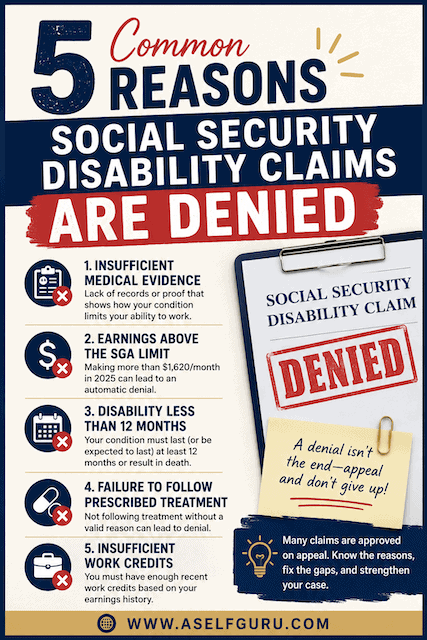
The first step is whether the individual is doing Substantial Gainful Activity (SGA). In 2025, making over $1,620 per month means automatic denial at this step without further medical evaluation.
Step two asks whether the impairment is severe.
Step three asks whether the condition meets or equals a listed impairment in the SSA’s Blue Book. Very few claims are approved at step three.
Most of these claims immediately move on to step four, whereby the Social Security Administration evaluates the residual functional capacity (RFC). This evaluation looks at the maximum capacity of the claimant to perform work after taking into account his or her impairments.
If the claim passes step four, then it moves to step five, where the SSA considers whether the claimant can adjust to other work in the national economy based on age, education, and RFC.
Knowing which step produced the denial matters greatly for understanding how to address it on appeal.

The Most Common Reasons Claims Are Denied
The following are the most frequent grounds for denial:
- Inadequate medical evidence: The SSA demands that there must be continuing documentation by the treating physician detailing how the disability affects one’s ability to engage in work-related tasks. Single examinations, old or outdated records, and records that only mention diagnosis but not functional impairment are often denied.
- Earnings above the SGA threshold: Any applicant earning more than $1,620 per month in 2025 is found not disabled at step one, regardless of the medical evidence. This is the most common non-medical reason for denial according to SSA statistical reports.
- A disability duration of less than 12 months: This requirement is another criterion for disability. The disability must persist for at least 12 months or must lead to death. A condition that is likely to improve within 12 months will not be considered as one meeting the definition of disability.
- Failure to follow prescribed treatment: When a claimant does not follow recommended treatment without a medically acceptable reason, the SSA may conclude the condition would have improved with compliance and deny the claim on that basis.
- Insufficient work credits: SSDI is a work-based program. Applicants must have earned enough work credits based on their earnings history. The required number of recent credits depends on age. Gaps in employment or low historical earnings can disqualify an applicant before any medical review occurs.
Why Medical Evidence Alone Is Often Not Enough
The most persistent misconception among denied applicants is that a diagnosis or a doctor’s opinion that someone is disabled will be sufficient. The gap between what a treating physician says and what the SSA accepts as evidence of disability is one of the most consequential in the entire process.
For claims filed since 2017, Social Security no longer gives special weight to a treating physician’s opinion simply because that doctor has treated the patient over time. Whether someone meets the legal definition of disabled is a determination reserved to the agency itself.
That does not make the treating physician’s input irrelevant. It means the opinion has to be earned rather than assumed. Adjudicators assess each medical opinion based on its objective evidence and consistency with the rest of the file. Clinical findings, laboratory results, imaging, and functional assessments are what give a physician’s conclusions weight, particularly when they support a specific residual functional capacity, meaning what the claimant can still do despite the impairment.
Sometimes, individuals who visit only one consultant doctor, have long breaks between visits, or whose medical history includes comments about pain without any functional limitations receive an RFC from SSA doctors, which tends to understate the severity of their condition.
The SSA’s Program Operations Manual System (POMS) gives fairly detailed guidance about what counts as acceptable medical evidence for each impairment category.
Firms that deal with SSDI denials at high volume tend to notice the same evidentiary holes popping up over and over again, no matter the location. A Downey Social Security disability lawyer, for instance, regularly works with clients to strengthen exactly this kind of medical documentation before a hearing, rather than after a denial has already been issued.

The Appeal Stages and What the Numbers Show
Reconsideration
The first appeal step is reconsideration, where a different examiner at Disability Determination Services reviews the same file. Roughly 84 percent of reconsideration decisions in fiscal year 2024 ended in denial.
It is also mandatory. A claimant has 60 days from receipt of the denial to request reconsideration, and SSA assumes the notice arrived five days after the date printed on it. Missing that deadline without good cause makes the original denial final. A claimant can still file a new application, but benefits are then calculated from the new filing date, which can cost months of retroactive payments.
ALJ Hearing
The ALJ hearing is where approval rates rise substantially. Approval rates rise sharply once a case reaches an administrative law judge. Across judges who decided fifty or more cases in fiscal year 2025, the national average approval rate was roughly 58 percent, the first stage in the process where approvals outnumber denials.
The RFC Assessment Is Usually Where Winnable Cases Are Lost
Most guidance on SSDI denials focuses on whether the applicant filed correctly and submitted medical records. Those guides rarely explain that the primary challenge in most denied claims is the RFC assessment.
SSA medical consultants who review records often issue RFC assessments that find claimants can perform sedentary or light work, even where the treating physician’s notes reflect more severe functional limitations.
That RFC assessment then travels through steps four and five of the evaluation, where vocational experts determine whether those assessed capabilities permit work that exists in the national economy.
Claimants whose RFC is assessed as sedentary but who are over 55 with limited education and no transferable skills may still be found disabled under the SSA’s Medical-Vocational Guidelines, known as the Grid Rules.
Much of the contested work in a disability claim centers on the residual functional capacity assessment, meaning what SSA finds a claimant can still do. Challenging it means producing and treating source opinions and physician statements that identify specific functional limitations and connect each one to objective findings already in the medical record.
What a Denial Letter Actually Tells You
Denials are not the end of the claim. SSA data shows that many claimants who are approved were denied at least once before reaching approval. The denial letter identifies the specific reason for the decision and the applicable deadline for appeal, usually 60 days plus an additional five days for mailing.
The reason stated in the denial determines what must change for the appeal to succeed. The SSA’s Benefit Eligibility Screening Tool is a useful application that helps to analyze which programs an individual can enroll in with regards to their earnings and employment status.